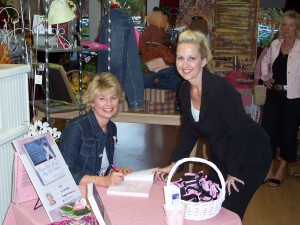
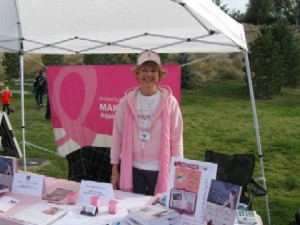
An Angel in Pink

I first met Melissa when she peaked into the room I had been speaking in for two days at a LifeWay “You Lead” conference held on the lower level of the Convention Center in Springfield, Illinois. Hubby and I were packing up my book table and speaking props.

Everyone had cleared out quickly when the conference ended, but suddenly, there was this sweet woman in a pink t-shirt asking, “Do you need any help?”

“We’re just packing up,” I said. “But do you know where the freight elevator is?”

The previous day, we had made numerous trips lugging book boxes and speaking gear down a long steep ramp to the meeting rooms in the basement, and I knew there was no way we could lug them back up the ramp.

She replied, “Yes, I know right where it is, and I can get you a flatbed cart. My name is Melissa and I just helped the LifeWay Store lady take boxes of books up to her car. I’ll go get the cart for you.”

A few minutes later, Melissa returned with a huge flatbed cart and started helping Dave put all our boxes on it while I cleaned up the room and folded tablecloths from the booktable. Melissa told me that she and her children work in a ministry where they learned to fold clothes neatly. She seemed in no hurry as it took me many tries to get the tablecloths back in their wrappers ready for the next book table, and Dave figured out the best way to load everything on the cart.

When all the “stuff” was on the flatbed cart, we asked where the freight elevator was and Melissa offered, “I’ll take the cart up the elevator while Dave goes to get the car. I’ll meet you outside.” And off she went with the heavy-laden cart. She shrugged off our protests that one of us should help her, “No problem! I just helped the LifeWay bookstore lady do the same thing.”

Dave hurried up the ramp to get the car and I finished tidying up the room. Then I headed off to find Melissa who was standing outside guarding our cart, waiting for Dave. When Dave arrived with the car, she insisted on helping us load the car!

We couldn’t stop thanking and praising Melissa for all her help. I told her she was our angel . . . we were both tired after two days of wonderful serving, and it would have taken us many trips using our little carts. I asked if she was going to see Beth Moore’s Living Proof Live event that night. She said yes, and remarked how surprised she was that women were already lining up at 3:00 when it didn’t start until 7 pm!

We both gave Melissa hugs and thanked her profusely, but she thanked us for coming to speak! Then, our angel in the pretty pink T-shirt was gone. Dave and I drove away still marveling at Melissa’s servant’s heart and God’s timing in bringing us a helping angel.

I have thought a lot about Melissa this week and wondered . . .

  • Would I have stuck around to be sure that everyone who needed help received it?
  • Would I have rationalized that I had already helped the LifeWay Bookstore lady and that was enough lugging books for one day?
  • Would I have just told Dave where the cart and freight elevator were, instead of obtaining the cart, helping load it, pushing it to the elevator, and waiting with it?
  • Would I have been impatient with us taking so long to get everything packed up just right, knowing that women were already lining up to get in to see Beth Moore and she could have gotten a good spot in line?
  • Would I have expected nothing in return for my efforts but the joy of serving?

I’d like to think so. How about you?

“Whoever wants to be first must take last place and be the servant of everyone else.” Mark 9:35
Return to top of page

You Are Priceless

This is the last Monday in October—a month in which I’ve been focusing on Breast Cancer Awareness Month in my Monday Morning Blog. Today, I invited Julie Coleman, author of Unexpected Love: God’s Heart Revealed in Jesus’ Conversations with Women, to share with us. As Julie jokingly talks about her cosmetic makeover, I was reminded of the free “Look Good . . . Feel Better” makeover I had at my radiation oncologist’s office. Most of us don’t feel very beautiful going through breast cancer treatment and it was so nice to have a professional give us a makeover, lunch, and free samples.

But Julie reminds all of us, healthy and not so healthy, that we are all precious in Jesus’ sight and He gives us our self-worth, value, and confidence, not our reflection in the mirror. Enjoy Julie’s post today—

 angie photo shoot2

I am no diva.

My daughter would roll her eyes at this statement and say, “No kidding!” Before every speaking event, Melanie insists on approving my outfit. She is afraid to let me leave the house without fashion supervision. “Put on some mascara,” she urges. “Lipstick will make you appear more professional.” I sigh and try to be obedient to her fashion sense, since I have none of my own.

On a shopping trip in Chicago with my cousins a few years back, we wandered into a chic makeup boutique. Noting the glamorous women browsing the store, I knew right away I didn’t belong there. But as I tried to inconspicuously peruse the aisles (so as not to embarrass my cousins), a makeup artist swept over. It was like I had a bull’s-eye painted on my forehead. She wanted to give me a makeover. I tried to explain that makeup wasn’t really a huge part of my daily routine. A face like mine would be a waste of her time. She insisted.

I felt sorry for her. She seemed so nice and sincere, so desperate to please. So I put myself into her hands.

The woman worked wonders. My eyes looked brighter and my face younger. I wrote down every product she used to perform her magic. Then I went shopping.

Please note: previously, the most sophisticated cosmetic purchase I had ever made was at the drugstore. So as I shopped, I didn’t think to look at prices. How expensive could eye shadow be? If only I knew.

Eventually I found myself in line with my little basket of purchases, again noticing the beautiful, stylish women now in line all around me. Obviously if you cared about your appearance, you bought your makeup in this place. Pretending to be a regular customer, I nonchalantly stepped up to the counter.

The young beauty behind the counter rang up my purchases. “Good news,” she enthused. “You have spent over $150! That entitles you to a special gift!” One hundred fifty dollars?? For blush and powder? I almost passed out. Excruciatingly aware of the Beautiful People surrounding me in line, I gulped and handed over my credit card, trying to look casual, as if this was a routine purchase for a diva like me. My hand was shaking. I thought I might possibly throw up, right there in front of this bunch of super models. How would I explain this to my husband?
My cousins and I left the store together. I was still shaken. “I j-just spent $150 on eye shadow,” I stammered. “Those people think a lot of their makeup.”

In the real estate market, a home’s value is determined by what someone is willing to pay for it. Similarly, the boutique’s confidence in their product was demonstrated by the cost they assigned to it. Apparently, I validated their assumption, since I willingly paid their price. The signature on my credit card slip indicated this makeup was indeed worth $150. At least to me. Apparently.

We can say the same for our own worth, according to Scripture. Our value has been determined by the price God was willing to pay for us.

“You were redeemed…with precious blood…the blood of Christ” (2 Peter 1:18-19).


Julie's book cover


Author and speaker Julie Coleman dedicates herself to helping others understand and know an unexpected God. Her new book, Unexpected Love: God’s Heart Revealed in Jesus’ Conversations with Women, was recently released by Thomas Nelson. Julie and her husband live in Annapolis, MD. You can find her blog at unexpectedgod.com.

NOTE:  This is the last week of our doubly reduced price of Dear God, They Say It’s Cancer: A Companion Guide for Women on the Breast Cancer Journey for National Breast Cancer Awareness Month. A perfect gift for a friend or for yourself.

Return to top of page

On a First-Name Basis with God


Carrying on the theme of Breast Cancer Awareness month, I’ve invited Ava Pennington to share her book, 
Daily Reflections on the Names of God. In  Dear God, They Say It’s Cancer, I encourage women as they struggle with breast cancer to talk and write to God. There are journal lines and prompts for writing “Your Love Letter to God” at the end of each chapter. In the “God’s Love Letter to You” sections, I personalize Scripture and sign it with the many names and assets of God.

Ava’s book will  enhance everyone’s personal relationship with our Lord and Savior. Today’s post is written by Ava Pennington.

Daily Reflections on the Names of God - lo-res

I’ve been a Christian for more than forty years, but it wasn’t until the past several years that I could say I’m on a first-name basis with God.

Don’t get me wrong. I knew Jesus Christ as Savior and Lord, and I was confident God knew me by name. But I didn’t realize until recently that, although God knew me by name, I was not as intimate with Him by name…specifically by the names and attributes He revealed for Himself in His Word.

The topic of the names and attributes of God is a popular one. There is no shortage of books, calendars, and cards on the subject. But I wanted to write a devotional that moved beyond learning a name and checking it off a list.

As I wrote Daily Reflections on the Names of God: A Devotional, I was struck by how many of God’s names and attributes I knew only on an intellectual basis. I had not stopped to consider what many of them meant to me personally.

For example, when I call God my Banner or a Consuming Fire, how did those names change the way I lived? Or did they change the way I lived at all? When the Bible refers to the Lord as the Bridegroom, what did that mean to me – someone who has been married for 35+ years? Or when Jesus is called the Lion of Judah, what did that mean to this city girl whose closest exposure to a lion occurred at the local zoo?

A Devotional

Because of my own need, I chose to structure this book as a devotional, applying three unique devotions to each of 122 names and attributes of God. Each name and attribute is explored from three perspectives: who God says He is, who we are in relation to that name/attribute, and how our relationships are influenced by that name/attribute.

At the end of the project, I knew God more intimately and I understood myself more clearly. For one thing, it changed the way I related to Him. My faith is not a “blind faith” since it rests on the proven character and ways of God. While I may not fully understand who He is until I get to heaven, His names and attributes provide glimpses into His divine nature.

A Renewed Prayer Life

Understanding why God has chosen certain ways to describe Himself also changes my prayer life. I’m not praying to an impersonal force out in the universe. I’m praying to our very personal God, who I know by name and who knows me by name. Whatever the subject of my prayer – whether worship, thanksgiving, interceding for others, or asking for myself – there is a name or attribute God has revealed for Himself that helps me relate to Him in that area.

Knowing what God says about Himself has also changed the way I teach and share Christ. God is not some ancient or outdated theological concept. Everything about who He is and how He works is relevant to us today. Knowing His names and attributes gives me the specific words to describe Him to others. It also helps me when others speak of who they think God is, because I have a starting point to say, “Let’s look at who God says He is!”

I hope you’ll join me in becoming more intimately acquainted with our great God. As you do, let me know the difference it makes in your life!

Ava Pennington is a writer, Bible teacher, and speaker. Her newest book, Daily Reflections on the Names of God: A Devotional, is endorsed by Kay Arthur, founder of Precept Ministries International. Additionally, Ava is co-author of Faith Basics for Kids. The first two books in the series are Do You Love Me More? and Will I See You Today? She has also written numerous articles for magazines such as Today’s Christian Woman, Power for Living, and Focus on the Family’s Clubhouse.

Ava also teaches a weekly, Bible Study Fellowship (BSF) class of 175+ women. She is a passionate speaker and teacher, and delights in engaging audiences with relevant, enjoyable presentations.

For more information, visit her at www.AvaWrites.com

To purchase Daily Reflections on the Names of God:

Amazon

Barnes and Noble

Christianbook.com

Deeper Shopping

© 2010 Martin Alan Grivjack Photography Martin Alan Grivjack Photography

Return to top of page

Help Your Friend With Breast Cancer Make It Through the Bad Days and Enjoy The Good Days

writingIMG_3857Signing at ExpressionsEagle-Walk1-300x225Grace Grace and me at signing

In loving memory of my “Grace Abounds”

October ushers in fall with thoughts of pumpkin pie and harvest colors, but for many women like myself, it’s also a reminder that October is National Breast Cancer Awareness Month. I was first diagnosed with breast cancer in October 2002, with recurrences in 2008 and 2011. So for me, and my breast cancer sisters, we’re also thinking pink. BTW pink and brown are great color combinations.

I found purpose in the pain of my first diagnosis by writing the book I wished I had going through my own journey, Dear God, They Say It’s Cancer: A Companion Guide for Women on the Breast Cancer Journey The hardest chapter to write was “It Could Come Back.” But come back it did come, twice! Any fears I had that my friends and family couldn’t, or wouldn’t, go through this ordeal with me again, were unfounded as they rallied around me each time with love, caring, support and most importantly, prayer.

In the following post, I have suggestions for how you can do the same for the breast cancer friend or family member or neighbor, or fellow employee, or acquaintance you barely know. Because with 1 in 8 women being diagnosed with breast cancer . . . you know a woman who has cried out in anguish, “Dear God, They Say It’s Cancer!”

_____________

“I’m sorry…but you do have breast cancer.”

Those shocking words crackling through my cell phone rocked my world eleven years ago. I was running errands…trying to outrun suspected bad news. After the doctor’s parting words, “You’ll be fine,” I fired up the car engine and started driving and dialing. The first person I called, after I told my husband, was my best friend, but she couldn’t comprehend the diagnosis. “A positive biopsy doesn’t mean it’s malignant, does it?” she asked.

It’s hard to know what to say or do when a friend or relative drops the bombshell news that she has breast cancer. Often our natural response is to recoil and retreat. Maybe it’s the fear of facing our own mortality or the time and emotion required if we do get involved. We ease our conscience by thinking: she would rather be alone right now anyway. Or she needs her family at a time like this. Or she has so many friends; I know someone will help her.

We may send a card or make a call offering to help, closing with “I’ll be praying for you,” then on we go about our life while her life crumbles. Yet the Bible clearly tells us to, “Help each other in troubles and problems. This is the kind of law Christ asks us to obey” (Galatians 6:2 NLV).

How can we put that verse into practical terms? What does it truly mean to help each other in troubles and problems? Perhaps you can glean some ideas from the ways my friends and family came along side me during my initial breast cancer journey and two recurrences.

Helping Her with the Bad Days


Don’t Just Offer to Help—Do Something Tangible

Most of us find it difficult to receive help; we are hesitant to impose on others. When asked the generic question, “How can I help you?” our common response is, “I’m fine, but thank you for asking.” Truthfully, we need everything, but we don’t know if the person is offering to mop our floors or pick up our kids from school—both of which we need, but are afraid to ask.

Another well-meaning comment I received was, “Just call me if you need anything.” Now how many women are going to pick up the phone and ask for help, especially if they are not feeling well? Again, we don’t know what the person is willing to do for us, and we don’t want to be a burden.

So instead of offering to help—just jump in and do something. If you know your friend well, you know where she needs help; and even if you don’t know her well, you know where all women need help. If she is in the midst of cancer treatment, she is going to need assistance with every area of her life, especially if she is single. Here are some practical ideas:

  1. Schedule her friends, family, and church to bring meals. Use your lunch break to take her lunch and eat with her.
  2. Offer to drive her to doctor’s appointments or treatments and take notes for her.
  3. Shuttle her kids to and from school or find someone who can.
  4. Sit with her during chemo treatments or accompany her to radiation. Talk, read a book to her, or just hold her hand.
  5. Take her children on a play date or to your house.
  6. Do her laundry.
  7. Do her grocery shopping. If she is too sick to dictate a list, take an inventory of her refrigerator and cupboards and make your own list.
  8. Answer her email.
  9. Bring her a gift that makes her feel feminine.
  10. If she feels like talking, sit and chat with her. When she doesn’t feel like talking, just be a presence in her home so she doesn’t feel alone.
  11. Babysit her kids so she and her husband can have some private time.
  12. Clean her house or pay someone to do it.
  13. Go with her to pick out a wig or prosthesis.
  14. Pick up prescriptions.
  15. Run errands.

My first surgery and treatment extended over the Christmas holidays, and we had six grandchildren at that time. I had bought their presents already but couldn’t imagine wrapping them. So my friend took all the presents home and wrapped them, as well as organizing other friends to deliver meals for three months. During my recuperation, she sat on my bed with my laptop, read my emails to me, and then sent my dictated answers. Later, she accompanied me to radiation, fixed my hair when I had a frozen shoulder, and stuck beside me through the entire cancer ordeal, even though she admits that her first reaction to my phone call on that dreaded diagnosis day was, “Lord, I don’t want to do this.” God assured her that she could do it, and she did.

Don’t Say, “I’ll Pray For You,” Unless You Mean It

At church a couple came up to greet my husband and me and asked if they could pray for us. That meant so much to me as we wrapped our arms around each other, and there on the church patio, this precious couple prayed for my recovery and Dave’s strength for the journey. When we finished, the wife asked where we needed help. I hesitated because I knew this woman didn’t like to cook, but Dave quickly interjected, “We could use a meal.” She didn’t flinch. She said they would be over the next night with dinner, and they were…and they prayed for us again.

“I’ll pray for you” is said too often with the casualness of “Have a nice day.” But a promise to pray isn’t just a feel good phrase. We are telling someone that we will petition God on her behalf, and we are living falsely if we don’t. I find it’s best to stop in the moment and pray right then. It keeps me honest and blesses the other person.

Helping Her Enjoy the Good Days


Be Happy with Her When She’s Happy

Cancer is a grim word. Overnight life becomes serious, tense, and laden with fear. There is very little laughter during those first shocking days following the “dreaded diagnosis.” But life continues and there are going to be good days interspersed with the bad. An insightful friend will capitalize on the moments of reprieve when there is an opportunity to laugh or smile. Be ready, because it may only last a moment, but the break from pain and fear is immeasurable.

If your friend is having an especially good day, avoid topics that you know will bring her down. You aren’t minimizing or making light of the seriousness of the situation, but you are giving her a recess from the intensity. Don’t fake happiness, but take advantage of humorous or lighter moments. Smile. Laugh. Be happy. Don’t let the serious eclipse the humorous.

I remember laughing at myself one day in the shower when I realized that I was so carefully not shaving under my left arm because of the lymph node surgery, that I also wasn’t shaving my left leg. I frequently retold that story so people could laugh with me.

Nurture the Little Girl Inside Her

When I was in the hospital, the nurse in charge of the breast-care unit gave me a white stuffed toy sheep named “Fleece.” Taking Fleece with me everywhere, I held him as a shield in front of my sore breast, tucked him under my arm as an armrest, and snuggled next to him in bed. For six months, I indulged my childish need for security and no one chastised me for it. In fact, they acted like it was normal. And I discovered when I was writing my book, Dear God, They Say It’s Cancer, that it was normal! One woman who shared her story in the book had a black stuffed sheep named “Lamby” that she cuddled in her hospital bed. Another received a baby-sized pillow, and she recalls, “That pillow became a part of my wardrobe for eighteen months.”

Comfort and Security Gifts

  • A stuffed animal, pillow, or quilt.
  • A favorite food.
  • A game she loves to play and play it with her.
  • A movie she loved as a kid and watch it with her.
  • A surprise reunion with childhood friends.
  • A tea party.
  • A fun hat—even if she hasn’t lost her hair, she might not feel like fixing her hair.
  • A new nightgown that buttons down the front.
  • An ice cream cone.
  • A nightlight.

Shower Her with Love

Kay Warren shared with me about her breast cancer experience, “I don’t know how we would have gotten through this difficult time without the outpouring of love and support from so many. I have not felt alone at all…which is such an amazing gift!” And that it is…love is the best gift you can give to your friend suffering with breast cancer. Don’t desert her when she needs you most. Right now, she requires extravagant love, and God will help you when your heart is breaking or it just seems too sad or too hard. John 13:34 tells us to love one another just as God has loved us. God is the author of love and He knows just what your friend needs, and He will show you how to love her when she is feeling unlovable.

Surprise her. What woman doesn’t love an unexpected gift or demonstration of how valuable she is to us? We were in the midst of a messy kitchen remodel when breast cancer assaulted me. Everything in my life seemed out of control. But I felt so loved the day I returned home after the painful needle biopsy and spotted amongst the rubble—gift bags full of treats with balloons attached and a card from two girlfriends assuring me they had been praying during the ordeal.

Ideas For Showering Your Breast Cancer Friend With Love

  • A Spa day at a salon, which treats women with breast cancer.
  • If she wears a hat or scarf, wear one too.
  • Tell her how much you love her and what a great friend she is.
  • Stick with her even when the treatment lingers on. Her biggest fear is that others will not endure the journey.
  • Include her in as many activities as she feels up to.
  • Go to a breast-cancer support group with her.
  • Plan a girls’ day or night out, when she feels up to it.
  • Sit and watch old movies with her—even if she falls asleep.
  • Do her makeup.
  • Pray for and with her.

The Bible assures us in Proverbs 17:17 that “A friend loves at all times.” What a privilege it is to put that verse into practice for your precious friend with breast cancer. You probably won’t be able to do everything I suggest and I hope you have ideas of your own, but as a three-time breast cancer survivor, I assure you there are three things that will endure through the good and the bad times—faith, hope, and love—and the greatest of these is love.

The Top Thirteen Things to Do or Say and NOT to Do or Say to Someone with Breast Cancer

Breast Cancer Support

Article includes excerpts from Dear God, They Say It’s Cancer: A Companion Guide for Women on the Breast Cancer Journey.

In honor of National Breast Cancer Awareness Month, we have further reduced the price of Dear God, They Say It’s Cancer at our website shop for the month of October. I will sign and personalize each book.

 Breast cancer book

Return to top of page

Think Pink, But Be Wise

Eagle-Walk1-300x225

Making Strides Against Breast Cancer Walk in Eagle Idaho (American Cancer Society)

This month, along with fall colors, you’ll also see pink splashed across newspapers, blog sites, magazines, kitchen appliances, cars, mayonnaise jars . . . as marketers and opportunists try to take advantage of our compassionate desire to help find a cure for breast cancer during National Breast Cancer Awareness Month. But beware: everything colored pink is not black and white. I have some tips on helping you determine a legitimate pink investment versus a pink opportunist.

While taking my early morning walk and praying for what I should write this month on breast cancer, I felt the Lord prompting me with the title of this blog. At the bottom of our road is a row of newspaper holders, and I finish my walk by getting our paper. I laughed aloud when I saw the color pink filling all the newspaper receptacles. The entire Idaho Statesman newspaper was pink!

“Even the sports page is pink!” my husband exclaimed. A front-page article jumped out at me: “Make Your Donation with Care: That Pink Ribbon Might be Lying; Find the Truth about Breast Cancer Giving.” I knew God was confirming that He did want me to warn about the dangers of scammers hitching up to the October pink bandwagon.

Make Your Financial Donations with Care

“Being a donor is a huge responsibility,” said Lynn Hoffmann, executive director of the Idaho Nonprofit Center. “I think it’s too often that donors do just give because they want to do something, but if they don’t do their homework, those dollars may not go where they want them to go” (Idaho Statesman). If you’re going to make a donation, do a thorough investigation of where the money will be going. Ask some basic questions:

  • How much of what I’m giving goes toward the charitable purpose and what is that purpose?
  • Is this a nonprofit, tax-exempt organization?
  • How much of a donation goes for administration, fundraising, and to the core mission?
  • Is the organization truly nonprofit and tax-exempt?
  • What are the executive’s salaries?

Question Solicitors

I receive frequent solicitation calls asking for donations to fund breast cancer research or to help breast cancer patients. I always tell them I am a three-time breast cancer survivor and wait to see their response. One sweet woman said, “God bless you and I’ll pray for your future health. We won’t call you again.” But others keep trying to get my money, and that’s when the red flag goes up. Be skeptical of any pushy solicitors.

Ask:

  • the name of the charity, website, phone number, and address, and tell then you will investigate and they can call back.
  • if the caller is an employee, a volunteer, or a telemarketer, whose company might be the ones banking the donations.

Research Online

Many websites and organizations collect and publish information on nonprofits:

  • GuideStar.org collects tax documents on federally registered nonprofits.
  • ProPublica is an investigative journalism nonprofit group with an easy to search database at projects.propublica.org/.nonprofits.
  • CharityNavigatigator.org rates some nonprofits.

Do some investigating yourself. The foundation or nonprofit asking for a donation should have a website: do they post annual reports? Who are their affiliates or partners?

My husband and I do not want our money going to any organization that supports, funds, affiliates with, or sponsors something we don’t agree with or support. For example, we stopped supporting Susan G. Komen several years ago when we learned that they fund Planned Parenthood. For several years before knowing this, I walked in the Komen races, wore their T-shirts, enjoyed the camaraderie of doing an event with other breast cancer survivors, and have Komen listed under National Contacts in the Sanity Tools of Dear God, They Say It’s Cancer. However, I had not done my homework.

Buyer Beware

KUOW.org points out:

“Susan G. Komen for the Cure is one of the largest breast cancer charities in the world. It partners with corporations to brand pink ribbon product lines for the month of October: pink Purina pet food, pink Yoplait yogurt, and pink buckets of Kentucky Fried Chicken, to name a few.”

When purchasing merchandise with a pink ribbon, ask the merchant: Are you donating any portion of the sale, and if so, to what organization?

I saw an advertisement for a pink/pink ribbon decorated Swifter WetJet with a “Cleaning For A Reason” slogan. They also gave a website www.cleaningforareason.org. At their website, I saw that they had a non-profit foundation and donations go to providing cleaning services for cancer patients. There were testimonials and contact information for further questions. I had no idea this service was available, and it looks like a good one.

But money spent to purchase a pink/pink ribbon Swifter WetJet is not going to the foundation; it’s going to Swifter and the merchant. So if I want a pink Swifter WetJet great; but if I want to donate to cleaning services for breast cancer women, I need to donate to their foundation.

Per Dr. Samantha King, director of Queen’s University school of kinesiology and health studies and the author of Pink Ribbons, Inc: Breast Cancer and the Politics of Philanthropy: Companies who use the Komen name pay Komen up front for the right to put Komen’s pink ribbon and name on their products. So your purchase doesn’t make any difference, nor does a portion of your purchase go straight to Komen. Money has already exchanged between Komen and the business. You can hear an interview with Dr. King at KUOW.org, and Google her name to read more of her comments on “pinkwashing.”

Sadly, there is a rampant marketing ploy of “pinkwashing”—raising the price of a pink or pink ribbon product. The assumption of the consumer is that the extra cost goes directly to fund a breast cancer foundation, but in most cases, it’s just making extra money for the business. If you know this and just want to wear pink, like I do for awareness purposes, that’s fine—but realize that’s what you’re paying for.

Everyone should eat healthy, especially women fighting breast cancer, so beware of foods packaged with a pink ribbon that wouldn’t be good for them (or you). Here are a few I’ve seen who will try to use the pink ribbon to get your emotional purchase:

Sugar—cancer loves sugar

Candy—sugar

Soft drinks—not good for anyone to drink

KFC—really?

I’ve Been Fooled Too

When first diagnosed with breast cancer, I vowed I would not wear pink or a pink ribbon because I didn’t want breast cancer to be my identity. But I soon realized it was my testimony to God’s faithfulness and something I couldn’t deny. So today, as a survivor, pink is my favorite color and I’m proud to wear clothing and jewelry with a pink ribbon—the universally understood breast cancer insignia.

I’m not picking on Komen, or promoting any organization, I just want you to be sure your money and donations are going where you think they are going.

You have to make your own decisions, and I would love to hear some organizations and foundations that you have researched—viable candidates for us to support in the fight against breast cancer. I think we have achieved awareness, what we haven’t achieved is a cure. I feel the answer is preventive research: why is breast cancer so prevalent and what can we do to protect ourselves against this dreaded disease? That’s where I’ll put my money. How about you? What are your thoughts?

______________

Note: About His Work Ministries is not a non-profit, tax-exempt foundation and we do not solicit or receive donations.

Dear God, They Say It’s Cancer: A Companion Guide for Women on the Breast Cancer Journey is the book I wrote to walk alongside my breast cancer sisters.

Breast cancer book


Return to top of page

Communicating More But Saying Less


Everyone looking down at a techie device

Does this conversation on a recent television sitcom between a mother and daughter regarding the son/brother who is away at college, resonate with you like it did with me?

Mom: I wrote him this big long email and he sent me a text! By the way, don’t send a text in response to an email. That’s just rude! He said, ‘Going to class gtg’. What does gtg mean?

Daughter: It means . . . ya know . . . Got to go.

Mom: What is ‘brb’?

Daughter: Be right back.

Mom: And then here’s the biggest insult, ‘love u’. Just ‘u’, not the whole word! I gave birth to ‘u’, don’t I deserve the ‘y’ and the o’? Then he sent me this little yellow smiley face. What’s that?

Daughter: A little emoji art for you.

Mom: I want to emoji art back. Show me how. Maybe he’ll respond to me then!

Are you laughing as hard as I did? I was watching this program with my adult daughter with whom I’ve had similar conversations. Here’s how the evolution of communication has spiraled with this daughter and with her brothers and sisters and their spouses! Anything similar happen in your family?

  • The phone: We had frequent conversations on old fashioned, landline phones.
  • Cell phones: Then came cell phones and we all went on the family plan and talked often.
  • Email: Free on the computer! No long distance charges or using cell minutes, so we wrote long emails regularly to each other. Even though I did miss hearing their voices, I loved receiving their newsy emails.
  • Facebook: I first got on Facebook to see what my daughter and grandkids were doing, since she stopped sending pictures by email and was only posting them on her timeline. Then, I started communicating with my readers more via Facebook, but my daughter started posting less.
  • Pinterest: “Mom you have to get on Pinterest,” so I did. Again, it was a great networking tool with my readers, but I seldom see my daughter on it anymore.
  • Smart Phones: All the kids got smart cell phones with virtual keyboards, which are a pain to type on, and if you try the speaker…who knows what embarrassing words you might be sending because the print is small and you can’t see the screen in the sunlight. But I got one anyway . . . . Even though they could receive email on their phones, the kids still didn’t respond to emails.
  • Texting: Then the kids did an intervention with my husband and me insisting that we add texting to our phone plan because that’s how they wanted to communicate with us. So we did, but again typing on phone keyboards is difficult—words are limited, and we have a limited texting plan. But they do respond better to texting, except our “conversations” now go something like this:

Wen wil u b here?

dnt no

How r u

Fine smiley face  or sometimes just smiley face

Meeting Them Where They’re At

I’ve seen some funny Facebook posts about moms and grandmas trying to text or use the speaker and the crazy things they end up “saying.” I haven’t mastered many of the imojis, and didn’t even know that’s what they’re called until I heard it on the above TV program. It took me forever to figure out how to make a heart, and I still haven’t mastered the wink, nor do I understand most other “imojis.”

However, I’ve learned: if I want to stay in communication with my kids and grandkids, I must learn to adjust, adapt, and appreciate new ways of communicating with a good attitude. It’s useless to continue sending emails that seldom get a reply. If texting is the way to get a response, then I’ll text until the next communication craze.

Some parents and grandparents throw up their hands in frustration over these communication trends and refuse to adapt. Then, they’ll complain about never hearing from their kids or grankids. We’re the losers if we stay stuck in techie avoidance, because technology is going to keep moving on whether we do or not.

Everyone’s Looking Down, Be Sure You’re Looking Up

If you observe most people today—families in homes, shoppers in the mall, diners at a restaurant or a coffeehouse—they’re looking down at their most prized possession, a cell phone. Yes, they also use tablets and Ipads, but a phone fits in a pocket or purse, and many simply hold it in their hand. Today’s generation seems desperate to stay in touch and be available, even if words are brief and few.

We can encourage our family and friends to have the Bible “AP” on their phone, and look down at that occasionally. YouVersion is a great resource and offers the Bible in all translations and yearlong reading plans. For years, I prayed that my daughter would want to read the Bible, and then her church challenged her to read the Bible via YouVersion on her smart phone. That worked for her because she checked her phone every morning, and she read the entire Bible in a year and 3 weeks. Now she gets YouVersion morning devotionals on her phone.

Remember what Satan tries to use for bad, God can always use for good.

Putting It All In Perspective

This is a great comparison of the Bible vs. the cell phone:

Ever wonder what would happen if we treated our Bible like we treat our cell phone? What if . . .

We carried it around in our purses or pockets?

We flipped through it several times a day?

We turned back to go get it if we forgot it?

We used it to receive messages from the text?

We treated it like we couldn’t live without it?

We gave it to kids as gifts?

We used it when we traveled?

We used it in case of emergency?

Unlike our cell phone, we don’t have to worry about our Bible being disconnected because Jesus already paid the bill!


BTW, I still use email, allot, so email me or visit me on Facebook or leave a comment. I love to hear from you.

Be right back       THX

Return to top of page

Dear God, We Need Friends!

Wedding Day

When Dave and I were newlyweds, we prayed and asked God to bless us with Christian friends. God answered beyond our wildest expectations and He continues blessing us with new friends. As one friend recently exclaimed, “You sure do have allot of friends!”

Ours was a second marriage for both of us. I had been single for 17 years, so my friends were mostly single and Dave, single only several years, had focused on work and his kids. We knew it would be important for us to have a social life comprised of couples who shared our values and beliefs, so we said an intentional prayer that God would bring those couples into our lives that He wanted us to have as friends.

Making Friends Outside the Box!

Dave and I met in a small group Bible study he was co-leading through Saddleback Church, where we were both members. This group was for people in the business world, but there were several couples in the group, so we had a head start on our quest for “couple friends.”

We were willing to look outside our church home of Saddleback Church, so when I heard about a course called Marriage Builders offered at another local church; we decided this was perfect preparation for our upcoming marriage. And you guessed it . . . we made another group of friends, had a great time socializing with the couples group at this church, and the pastor who taught Marriage Builders officiated at our wedding. A couple in the group we became very close with videotaped our ceremony.

While considering where to go on our honeymoon, I heard an advertisement on the radio for a cruise to the Caribbean with Calvary Pastors Chuck Smith, Jon Courson, and David Hawking. I thought: What a great way to spend our honeymoon on a cruise with hundreds of Christian couples. It didn’t matter what church they attended—we were all in the family of God. It was great fun being the “newlyweds” on the cruise and we came home with a new group of friends.

Come Join Our Small Group or We’ll Form One

Dave and I were intentional about asking other couples we met at the gym, at church, in the grocery store, friends of friends . . .  if they would like to join our small group Bible study. Soon the focus of the group changed from business-oriented to topical and everyone was welcome to join. As the group expanded, so did our circle of friends.

Several years into our marriage, Gary Smalley came to Saddleback with his Making Love Last Forever conference. Dave and I took a training to lead Making Love Last Forever couples groups and found ourselves leading a group of much younger couples, who had all been married longer than we had, but were newer in their faith. The couple who hosted that group in their home refers to Dave and me as, “The most influential couple in their faith journey.” That’s humbling.

We’re Moving—Opportunity for New Friends

We bought a “writing” cabin in the mountains and immediately started making new friends, even though we were “weekenders.” We attended the local church, invited neighbors to walk, come over for dinner, play games . . .  and soon people were saying I should run for mayor because I knew so many people.

Then two years ago, we made the major move from California to the mountains of Idaho where we knew no one except our daughter’s family, who live over an hour away. I wondered how we would make new friends, but I didn’t wonder for long. Again, we joined the local community church where the members embraced and welcomed us. Soon we had invitations to potlucks, football parties, game nights, and a neighbor reached out to me and we’re best friends and walking buddies—even though we our theology differs, we both love the Lord. Another group of friends surrounded us.

Vacationing with the Family of God—A Glimpse of Heaven

In my blog post “Love Song Couples Getaway,” I shared the story of Dave and me deciding to celebrate our 20th anniversary . . . just as we did on our honeymoon . . . with a group of Christian couples we didn’t know. It was the best vacation of our married life, and in just one week, we made friends with couples who have become near and dear to us. They live in Southern California, where we just moved from, but we still have our mountain cabin and grandkids in So Cal and recently joined these couples for a reunion.

Staying in Touch

The friend I mentioned in the opening paragraph who exclaimed, “You sure do have allot of friends,” was reacting to the recap of our trip to Southern California. We told him about:

Lunch with the wife of that host couple of the Making Love Last Forever group, whom we hadn’t seen in 10 years after they moved out of So Cal. We picked up the conversation like we had never been apart. I discovered they would be in So Cal the same time as us on Facebook—a great way to keep in touch with friends.   Lunch with Robin Coleman
We had a reunion with three couples we met on our Love Song Couples Getaway vacation in May. Love Song Couples Getaway reunion

Enjoyed a lovely sunset dinner with couples from that original small group Bible study where Dave and I met, and we’re always welcome to stay with them when we return to Orange County.

Dinner with our original couples small group friends

We then spent a week at our So Cal mountain cabin socializing and visiting with our friends and neighbors, including my author friend Joanne Bischof and her husband Noah

Dinner with author Joanne Bischof and Noah

Friendships Are Our Witness

In Praying for Your Prodigal Daughter, I tell the story of my daughter Kim contemplating becoming a Christian and worrying that she might not have any friends. But then, she said, “Well you and Dave have so many friends and you’re always having a good time. And I guess I don’t need those friends who won’t accept me.” When she made that comment, Dave and I had only been married five years …we were just getting started on making friends.

As Christians, we need to remember that someone is always watching us to see how we interact with others and are we open to fellowshipping.

We must also befriend nonbelievers or how else will they learn about the blessings and joys of knowing Christ. But those we “hang with”, and share our lives with, should share our morals and values, and we should be a support system for each other.

Proverbs 17:17
A friend is always loyal, and a brother is born to help in time of need.

Let’s be friends on Facebook!

I would love to hear how you make treasured friends.

Return to top of page

Will You Be My Spiritual “Big Sis”? Guest Post By Pat Ennis

Our guest blogger today, Pat Ennis author of The Christian Homemaker’s Handbook , confirms my passion and mission to encourage churches to be more intentional about applying Titus 2:3-5 in the lives of the women in their congregations. We often think of a mentor as a spiritual mom, but Pat offers the perspective of a mentors being a spiritual big sister—


 MM3891 Lo-Res

My commitment to mentoring comes from my early years as a young professional when there was an absence of older women who were willing to lend a helping hand. Many offered criticism, few offered help. I vowed that if I survived, I would be willing to help others on their spiritual and professional journeys. The young women whom I have mentored serve our Lord throughout the world. I love the times when I answer the phone to find one of them on the other end of the line. Their personal visits are always a blessing and their e-mails, cards, and letters often arrive to encourage and minister to me on challenging days. I am looking forward to our reunion in heaven and count it a privilege to be “the older woman” in their lives!

The strategy outlined in Titus 2:3-5 provides the biblical foundation for understanding the mentoring relationship, while the book of Ruth details an example of its application.  However, despite the fact that Titus 2:3-5 is an instruction, not a suggestion, to Christian women . . . few are willing to mentor.  Excuses range from, “I don’t have time” to “no one cares what I have to say”.

A Revealing Survey 

The “Perceptions of Homemaking Study,” which established the foundation for The Christian Homemaker’s Handbook, revealed the twenty-first-century woman’s knowledge of—and ability to perform successfully—life skills commonly associated with the management of the home. In the study, 2,315 respondents completed a 30-item survey. Each respondent could list four skills to complete this statement: The homemaking skills many Christian women lack are. . . .

The 4,599 responses revealed that many younger Christian women lack the homemaking skills of cooking, sewing, organization, time management, hospitality, and cleaning.

Women who would be considered “older women” in their churches (35 and above) comprised 62.9% (1,459) of the respondents. They overwhelmingly replied that they are confident in their homemaking skills. However, as they responded to the open-ended questions, the women expressed concern for the lack of biblical character and practical skills possessed by the younger Christian women (15-34 in age) they encounter.

A Break in the Mentoring Cycle

The results suggest a break in the circuit: he Titus 2:3-5 model is being ignored in our evangelical cycle of women’s ministry. The survey results pose a thought-provoking question: Have the younger women become less teachable or have the older women failed to teach?

Seeing answers, I spoke with the editor of the Biblical Womanhood Blog to discuss how the Titus 2:3-5 passage can be practically applied to a mentor/mentee relationship. A gifted, well-educated young woman in her mid-twenties, she provided some insight to what comprises a meaningful mentoring relationship. She commented that in her opinion a mentor is like having a “big sister” who is willing to make a life-to-life relational investment—nurturing, involved, invested, and a willingness to walk with you through “your journey”.

Probing a bit deeper I asked where the “spiritual big sis” draws the line between being interested and intrusive. I so appreciate her suggestions:

  • Ask questions rather than make demands.
  • Serve instead of control.
  • Demonstrate a willingness to mentor.
  • Be an available voice.
  • Avoid perfectionism. The scriptures challenge us toward excellence. Perfectionism is God’s responsibility. That means the mentor needs to be willing to share her “mess ups” so she doesn’t give the impression she walks on water.

Formal or Informal Mentoring

I believe that mentoring relationships can be either formal or informal and have some practical suggestions for each to share with you.

Formal Mentoring Suggestions

  • Reading and discussing a Christian women’s book together (for example, Lies Women Believe and the Truth that Sets Them Free by Nancy DeMoss, Loving God with all Your Mind by Elizabeth George, or my book with Lisa Tatlock, Becoming a Woman Who Pleases God).
  • Completing a study like Janet Thompson’s Face-to-Face Bible study series, written for mentors and mentees to do together.
  • Reading and discussing a commentary on a book of the Bible (such as Titus).
  • Memorizing Scripture or keeping a prayer journal and then spending time talking and praying together each week.

Informal Mentoring Suggestions

  • Discussing questions raised by the younger woman (regarding relationships, skills, or life experiences).
  • Working on projects together such as planning events or holidays to learn practical skills in management (set goals then work together to accomplish them).
  • Simply spending time together talking and letting the younger woman see your life and family.
  • Sharing your knowledge about practical home management (menu planning, cleaning house, or paying the bills).

Whether formal or informal, “The Seasons of Mentoring Cycle” begin when younger and older women regularly spend time together.

Pat Ennis is a distinguished professor of Homemaking and Director of Homemaking Programs at Southwestern Baptist Theological Seminary, Fort Worth, Texas. She is a speaker and author, and her most recent release is The Christian Homemaker’s Handbook with Dorothy Patterson (Crossway, March 2013).

Christian Homemaker's Handbook

Return to top of page

Ways to Survive a Husband’s Lay Off! By Mary Aucoin Kaarto

I wrote my latest book Dear God, He’s Home: A Woman’s Guide to Her Stay-at Home Man! to help wives with husbands home for any reason—disability, illness, unemployment, retirement, reintegration from military deployment—whatever has caused hubby to be home 24/7.

Our guest on Monday Morning Blog is fellow author Mary Kaarto who wrote a book to help men and women who are out of work. Today’s article speaks to wives with laid off husbands. Mary and I share the same passion to help marriages thrive and survive during the transition of having a stay-at-home man!

 HELP for the LAID OFF

One day you’re out getting your nails done and arguing with Little Sally over which backpack to choose for the new school year, blissfully unaware of how blessed you are that this may be the biggest problem you have. Then your husband drags through the door with a look like you’ve never seen before.

You instinctively know something is wrong, because he heads straight to wherever he goes to hide—the bedroom, his home office, the backyard . . . . Ecclesiastes 3:7 reminds us there is a time to be silent and a time to speak. Only you know whether it’s best to leave him alone for a while – or immediately go find him to ask what is wrong.

For Better or Worse . . .

Most traditional marriage vows include “for better or worse, for richer or poorer” and layoffs provide a challenging – but phenomenal – opportunity for couples to live up to their vows. To grow closer to God and each as the wife supports her husband. Wives can, and should, consider helping their husbands through this gauntlet of pain that seems like it will never end.

Ways to Help a Laid Off Husband

We’re all familiar with the boring drills on airplanes before take-offs, when the airline’s employees remind us to put our oxygen masks on first before helping others, during an emergency. In a similar fashion, it’s important that wives don’t lose sight of their own needs during this time. We cannot take care of our husbands, if we don’t take care of ourselves as well.

  • If you’re not already active in a women’s Bible study class or small group, please consider joining one. We women are emotional creatures, genetically wired and created by God to talk ninety-miles-a-minute at any given time! Women NEED to express their thoughts and feelings pretty much all the time, but most husbands cannot handle hearing them at length, especially during a layoff. The poor guys need a break, so consider venting to your family and friends right now.
  • One of the highest priorities wives have is to pray for their husbands on a daily basis, in good times and bad. If possible, find a good devotional book for couples to share together each evening after supper and the kids are in bed. Having a regular quiet time together allows couples the security of a routine during a shaky time, and it gives them some semblance of normalcy and something to look forward to at the end of the day.
  • Years ago, there was a popular country & western song by Willie Nelson and Waylon Jennings, which addressed the importance of “getting back to the basics of love.” Remember what’s most important in life: faith, family, and friends. It’s not about buying things you can’t afford with money you don’t really have so you can keep up with the Jones. Sadly, in today’s economic climate, the Jones may be headed to bankruptcy court.
  • When you have time, make an itemized list of your expenses – including upcoming costs for getting kids back to school, Christmas and birthdays – and see if you can reduce or eliminate them all together. Depending on the age of your children, they may be old enough to understand and learn to be happy with one special gift, rather than many, to open this year. I know, as a mother, this will be very hard to do, but your family’s survival depends on this.
  • Show your husband that you’re willing to cut back as much as possible without throwing a fit; it will help lift unnecessary burdens from his shoulders. I’d like to add that this layoff will not kill your family or your kids; it will bring you closer together and your kids will learn some very valuable lessons like … the value of a dollar, money doesn’t grow on trees, how to create and stick to a budget, etc.

All He Needs Is A Little Respect

Like apples of gold in settings of silver is a word spoken in right circumstances. – Proverbs 25:11

  • Many, if not most, men say the number one need from their wives is respect. By speaking highly of your husband – especially to him and in front of others (but within his earshot) – you help boost his self-esteem when he needs it most and remind him of your love. Men have fragile egos; don’t hurt them unnecessarily by belittling, especially when the world’s already beating them to a pulp.
  • Keeping the lines of communication open is important for both husbands and wives, but it’s common for men to shut down when they’re in pain. Pastoral counseling may prove helpful, whether receiving it together as a couple or on an individual basis. Going before God, our wisest Counselor and the best Comforter we could ever have, is always the best idea.
  • Physical affection and loving gestures, maintaining direct eye contact, giving your undivided attention whenever possible.
  • Continue with your family’s normal life rhythms.
  • Most husbands need sexual intimacy like women need to talk, so creating, and occasionally initiating, opportunities for making love may be a good idea. Pray about this, because your husband may be under such pressure that he’s unable to perform sexually and you don’t want him to perceive this as another “failure.”

Although I learned to thrive, and not just survive, during my own two layoffs, I did so as a single mother. From these difficult-but-doable life experiences, I learned that being laid off can be, and often is, one of the best things that can ever happen to someone.

It all depends on their response. Will they turn to, trust, and follow God, their Divine Employer – or will they continue to rely on their own human strength and wisdom? As one of my favorite pastors and authors, Dr. Charles Stanley, always says, “Trust and obey God, and leave all the consequences to Him.”

My web site, www.marykaarto.com, includes a “10 Ways to Support Your Husband During a Layoff” free handout, among other information.

My free devotionals blog is found at www.facebook.com/helpforthelaidoff.

HELP for the LAID OFF is available at bookstores, including Amazon and all online web sites.

About the Author

 Mary Kaarto2

Mary Aucoin Kaarto is a long-time follower of Jesus Christ, happily remarried after nearly 20 years as a contented Christian single, devoted mother, and “Nammi” to two precious grandkids. She is also the author of HELP for the LAID OFF, a Christ-centered book about trusting God during a layoff. In her former life, Mary covered the oil & gas and healthcare industries in addition to writing numerous freelance articles for the Houston Chronicle and other various publications.

Return to top of page

Special Blessings of Grandparenting a Special Needs Child by Kate Thomas

Our guest today is Kate Thomas, author of Grandparenting a Child with Autism, who shares the blessings of being a grandparent and the special blessings of Grandparenting a special needs Grandchild.

Grandparenting

“Being a grandparent is the only experience in life that can’t be overrated.”

These were the words from a friend who is a grandparent like me. Maybe I wouldn’t go quite that far, but grand-parenting has been, and is, one of the greatest joys of my life.

God has blessed my husband and me with four wonderful grandchildren: two boys and two girls. I pray for each of them every day…throughout the day. Today was the first day of school for Luke, John Paul and Mary Esther. Last night, John Paul asked his dad to have a prayer with him for the new school year ahead. His daddy would have done this anyway before bedtime, but John Paul needed some extra prayer time.

All of us have special needs of one kind or another. But our Katie, the oldest grandchild, has a greater need than my other grandchildren. At the age of four, Katie was diagnosed with autism. It would be difficult to describe the blow this was to our family. She was such a bright and beautiful little girl, but the characteristics of autism were evident.

 One of the many special memories I recall of Katie’s childhood was at a worship service at our church. We were singing “O How I Love Jesus.” Katie sang along for a few seconds, and then, with four small fingers on my cheek, she began to turn my face toward her. I whispered more than once “Katie, you know this song. Sing with me.” The fourth time she turned my face toward her, I bent over to hear what was on her heart. She said, “I love Jesus, too!” It would be difficult to over rate that experience!

I often think what if I had never listened to her heart and heard those beautiful words. National Grandparents Day is coming September 8th. Let’s listen to our grandchildren’s hearts as well as their voices.  

_________________________

Grandparents day

 September 8, 2013 is National Grandparents Day. To read more about how grandparents can celebrate and pray for our grand children read the Monday Morning Blog Post: Celebrating National Grandparents Day.

About the Author

Grandparenting a Child with Autism

Kate Radford Thomas’ books include New Every Morning A Daily Touch of God’s Faithfulness, Grand-parenting A Child with Autism A Search for Help and Hope, and Mother Duck Knows the Way. Kate is the mother of two and the proud grandmother of four. Her oldest grandchild, Katie, has autism, and Kate has spent much time trying to help Katie reach her full potential. Kate is the founder of the Kentucky Christian Writers Conference, where she has served for 18 years. She also helped found a camp for children with autism. Along with writing, Kate continues to speak throughout Kentucky. Most of all, she loves her family, friends, and wonderful Lord!

HSLT_1667

Return to top of page
Return to top of page · Copyright © 2026 Crown Laid Down Designs All Rights Reserved · Our Privacy Policy